
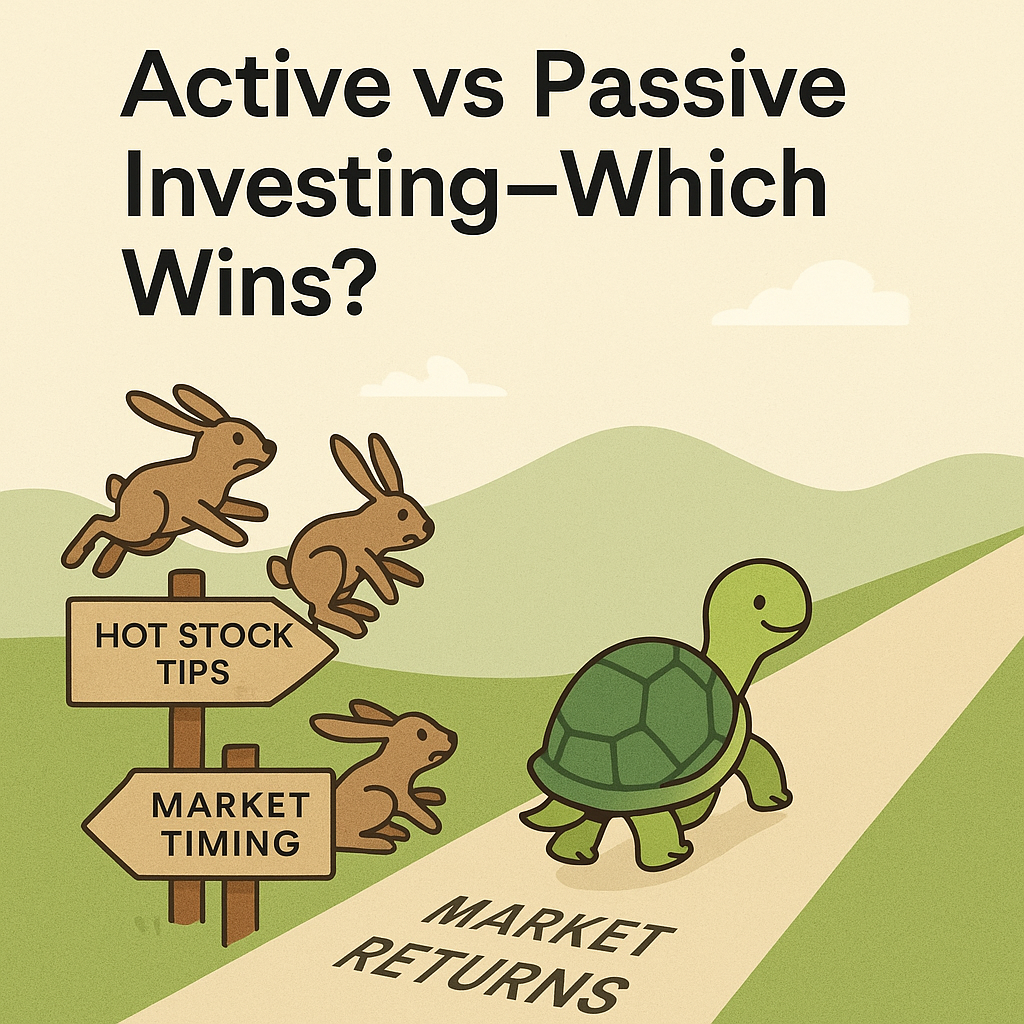
Investing is one of the most powerful tools for building wealth—but it’s also filled with opinions, strategies, and philosophies. Whether you realize it or not, every investor follows a particular approach that shapes how they manage risk and seek returns.
At the heart of the investing world lies a key question:
👉 Should you actively try to beat the market, or passively own it for the long haul?

📈 The Allure of Active Investing
Active investing has long been romanticized in books, movies, and financial media. The idea is simple: if you pick the right stocks, time the market well, or follow expert fund managers, you can outperform the market.
Within active investing, you’ll find several approaches:
1. Value Investing (Buying Undervalued Companies)
Inspired by Benjamin Graham and Warren Buffett, value investors look for stocks that are trading below their “true” worth, waiting for the market to recognize their value.
2. Growth Investing (Betting on High-Potential Companies)
Growth investors focus on companies with strong potential for rapid earnings growth, often paying a premium for promising future profits.
3. Technical & Momentum Investing
Instead of studying a company’s financials, technical investors analyze price charts and market trends, believing past patterns can hint at future performance.
4. Macro Investing
Macro investors make broad bets based on economic trends, interest rates, and global events—a style often used by hedge funds.
🚨 Why Most Active Investors Underperform
The SPIVA Report (S&P Indices Versus Active) tracks thousands of actively managed funds—and year after year, it reveals the same reality:
Over 80% of active funds underperform their benchmarks over 10–15 years.
Why does this happen?
- High fees: Active funds often charge 1–2% annually. Over decades, that’s a huge drag on returns.
- Efficient markets: In today’s world, millions of investors analyze the same data—making it hard to consistently find mispriced opportunities.
- Emotions: Fear and greed cause investors to buy high, sell low, and chase past performance.
- Luck, not skill: A fund manager who beats the market one year may underperform the next.

📊 The Case for Index Investing
Instead of trying to outsmart the market, index investors simply own the market—at the lowest cost possible.
Pioneered by John Bogle, founder of Vanguard, index investing means buying a diversified portfolio that tracks a market index, like the S&P 500 or MSCI World.
Why Index Funds Work:
- Ultra-low costs: Expense ratios as low as 0.03%
- Broad diversification: Hundreds or thousands of companies in one fund
- No need to time the market: You benefit from the market’s natural growth
- Better long-term results: Historically, most index funds outperform the majority of active managers
📷 Image suggestion: Pie chart showing global diversification in an index fund
Alt text: “Diversified global index fund example”

⚖️ Active vs Passive: Which Should You Choose?
The dream of beating the market is tempting. But the data shows that most investors are better off with a passive strategy—especially when factoring in costs, time, and emotional stress.
Index investing allows you to:
- Keep costs low
- Stay invested through market cycles
- Focus on long-term growth instead of short-term noise
✉️ Join Our Investing Community

🐢 Slow and steady wins the race.
Subscribe to The Investor Compass newsletter and get:
- 📘 A free Tortoise Starter Portfolio Planner
- 🧠 Weekly behavioral investing tips
- 📊 Tools to build a low-cost, diversified index portfolio
📩 Subscribe now and start your journey toward stress-free investing.